
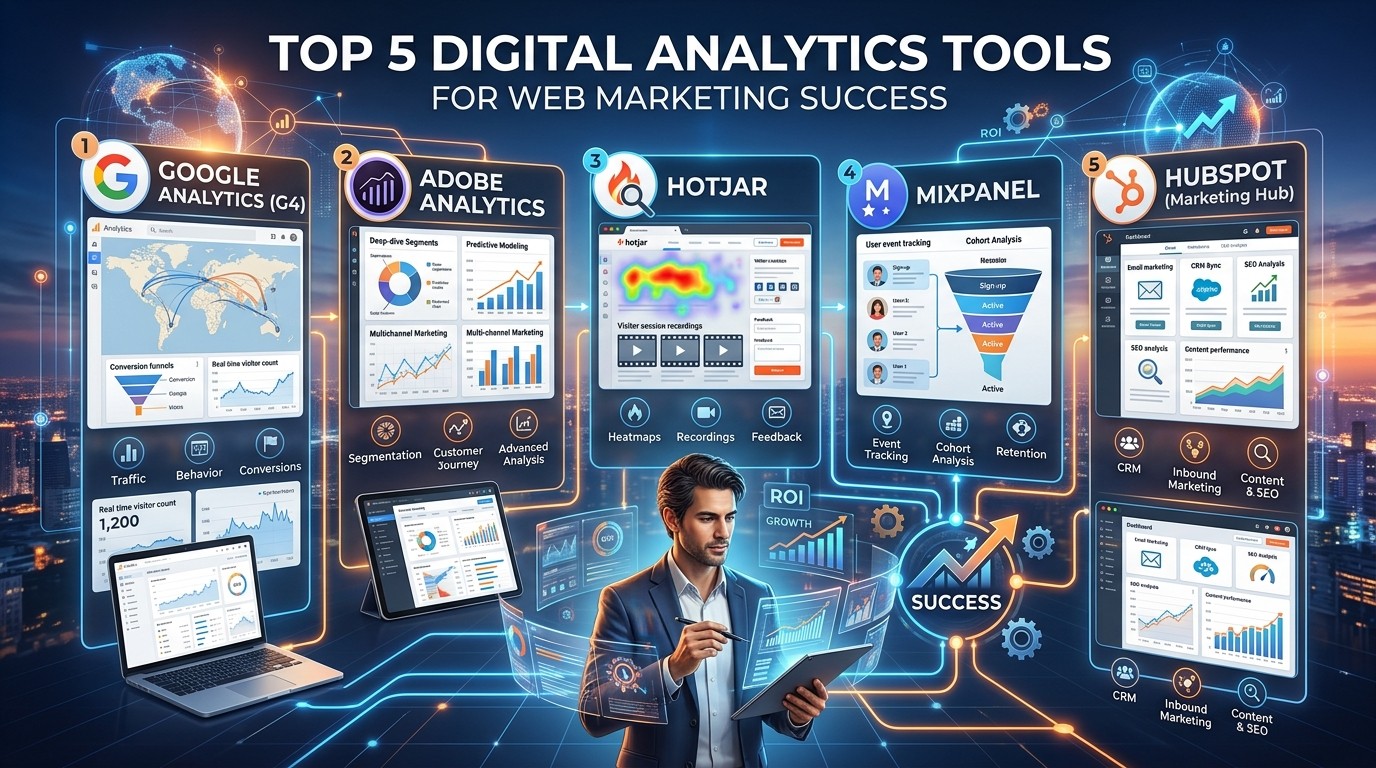
Top 5 Digital Analytics Tools help marketers see what visitors do, why they convert, and where to improve campaigns, turning web traffic into clearer, smarter action.
Top 5 Digital Analytics Tools are not interchangeable, because each one solves a different part of the marketing problem. Google Analytics helps teams understand website and app behavior and connect that understanding to marketing ROI. Adobe Analytics focuses on enterprise digital analytics, including unified measurement and AI-supported insights. Matomo emphasizes privacy-first ownership and GDPR-friendly analytics. Mixpanel centers on product and behavioral analysis with funnels, retention, and interactive reporting. Hotjar focuses on behavior insight through heatmaps, session replay, surveys, and user feedback.
Top 5 Digital Analytics Tools are valuable because web marketing now depends on clarity rather than guesswork. A business can run ads, publish content, and send email campaigns, but if it cannot see what visitors actually do, it will keep repeating the same mistakes. Analytics makes the invisible visible, which is why it is one of the highest-leverage decisions in digital marketing.
The best way to use Top 5 Digital Analytics Tools is to match the tool to the question. Some tools are better for traffic and acquisition. Some are better for journey analysis. Some are better for privacy-sensitive environments. Some are better for behavior and retention. That difference matters more than brand popularity because a tool only works when it fits the work.
In broader stack conversations, B2B Marketing Tools, Marketing Alignment Tools, Data Visualization Tools, and Marketing Analytics Tools often overlap, but they are not the same thing. A business may use one tool for campaign execution, another for cross-team coordination, another for dashboards, and another for performance measurement. Top 5 Digital Analytics Tools sit at the measurement layer, where decisions become evidence-based instead of opinion-based.
How to evaluate analytics tools correctly

Top 5 Digital Analytics Tools should be judged on more than feature lists. The first question is whether the tool answers the business’s real marketing questions. A content team may care about pages, sessions, and conversion paths. A SaaS team may care about activation, retention, and event funnels. An enterprise team may care about governance, customer journey measurement, and cross-channel reporting. The right platform should make those questions easier to answer, not harder.
A second question is how the platform handles data structure. Google Analytics uses event-based data and includes privacy controls like cookieless measurement and predictive capabilities. Mixpanel is built around events, users, and properties. Adobe Analytics supports rich digital analytics across web and mobile and emphasizes in-depth analysis and reporting. These differences shape everything from setup to dashboard design.
A third question is how much control the team needs. Matomo offers self-hosting, data ownership, and GDPR-oriented privacy positioning. Adobe targets enterprise teams that need scalable measurement and AI-assisted insights. Hotjar focuses on qualitative understanding through heatmaps, session replay, and surveys. Top 5 Digital Analytics Tools should be chosen with those operational realities in mind.
Tool 1: Google Analytics
Google Analytics is the most common starting point for web marketing measurement because it is built to help teams understand how people use websites and apps, and to improve the customer journey and marketing ROI. Google says GA4 collects both website and app data, uses event-based measurement, and includes privacy controls and predictive capabilities. That makes it useful for teams that want broad visibility without immediately moving into enterprise complexity.
Within Top 5 Digital Analytics Tools, Google Analytics is usually the most practical first layer because it combines reach, familiarity, and a relatively low barrier to entry. It is strong for traffic analysis, source/medium understanding, conversion tracking, and campaign performance review. Google’s documentation also points to developer tools for managing integrations at scale, which matters when a team wants the analytics setup to grow with the business.
The main reason marketers keep using Google Analytics is simple: it gives a common language for web performance. If you need to understand which pages bring traffic, which channels contribute to outcomes, and how users move through a site, it is a reliable baseline. In a Top 5 Digital Analytics Tools comparison, that baseline role is extremely important because it anchors the rest of the stack.
Google Analytics is especially useful when the team wants one platform that spans website and app measurement. Its event-based model and predictive capabilities help teams move beyond old session-only thinking. That matters because modern users move across devices and touchpoints, and marketing teams need a system that can keep up.
Tool 2: Adobe Analytics
Adobe Analytics is the enterprise-grade option in this list. Adobe positions it as digital analytics for web and mobile, with features such as unified marketing measurement, streamlined paid media analysis, causal AI models, scenario planning, and forecasting. Adobe also describes it as helping teams examine visitor behavior across digital properties through data collection, in-depth analysis, reporting, and behavioral insights.
Among Top 5 Digital Analytics Tools, Adobe Analytics stands out when the organization needs depth, scale, and more advanced analysis workflows. Adobe’s platform is designed to support high-volume data exploration and accessible insights for marketing professionals and analysts. It is not just about seeing traffic. It is about understanding performance at a detailed level and using that understanding to guide decisions.
A major strength is the way Adobe frames digital analytics around web and mobile together. The platform emphasizes content, channel, and marketing performance, and its documentation highlights segmentation, real-time data, and multi-source analysis. That makes it a strong fit when marketing complexity is high and teams need enterprise-style reporting discipline.
Top 5 Digital Analytics Tools often look similar at a distance, but Adobe becomes more compelling as the measurement problem gets harder. When a company needs a complete customer view, AI-assisted exploration, and strong reporting structure, Adobe is often the more serious choice. It is built for organizations that treat analytics as a strategic function rather than a side task.
Tool 3: Matomo
Matomo is the privacy-first option in Top 5 Digital Analytics Tools. Its homepage emphasizes accurate, GDPR-compliant analytics with full data ownership and self-hosting options. The platform also says it is trusted by 1 million organizations worldwide. For businesses concerned about ownership and privacy, that positioning is a major advantage.
Matomo is especially attractive when the team wants analytics without depending entirely on a third-party ecosystem. Its features list includes reporting tools, custom reports, segmentation, graphs and visualizations, roll-up reporting, and other practical capabilities. That makes it useful for teams that want a deep analytics layer with a strong control mindset.
What makes Matomo different from many other tools in Top 5 Digital Analytics Tools is the emphasis on ownership. Some teams care deeply about where their data lives, who controls access, and how much of the stack is under their authority. Matomo responds to that concern directly with self-hosting and privacy-oriented messaging.
Matomo also matters because privacy expectations keep rising. A marketer may not choose it solely for compliance reasons, but privacy can be a deciding factor when legal, brand, or internal policy requirements are strict. In those cases, Matomo offers a cleaner fit than a more data-sharing-heavy approach.
Tool 4: Mixpanel
Mixpanel is the behavior and retention-focused option in Top 5 Digital Analytics Tools. Mixpanel says it helps teams track user behavior, measure conversions, improve retention, and answer product questions with interactive reports. Its docs describe the platform around events, users, and properties, which gives teams a structured way to understand what people actually do.
Mixpanel is strongest when the business wants event-level clarity. The platform emphasizes product analytics for mobile, web, and more, and it offers immediate access to user behavior and trends. That is useful for marketers and product teams who care about funnels, engagement, and retention rather than just traffic totals.
Within Top 5 Digital Analytics Tools, Mixpanel is the one that often feels most action-oriented for product-led teams. It is built to show how users move through experiences, where they drop off, and which behaviors correlate with conversion or repeat use. That makes it valuable when growth depends on understanding the journey, not just the source of traffic.
Mixpanel also continues to expand around experimentation and feature flags, which reinforces its role in teams that want analytics tied to product improvement. The platform’s reporting style is especially useful when people need quick answers without heavy technical overhead. For the right team, that makes it a high-impact choice.
Tool 5: Hotjar
Hotjar is the behavior insight and feedback tool in Top 5 Digital Analytics Tools. Its homepage highlights heatmaps, session replay, funnels, and surveys, while its help content describes it as a product experience insights platform that provides behavior analytics and feedback data. This makes it especially useful for understanding why users behave the way they do on a site.
Hotjar is different from more traditional analytics tools because it focuses on qualitative understanding alongside quantitative signals. Heatmaps show clicks, movement, and scroll behavior. Session replay lets teams see what users saw. Surveys and feedback tools help explain what the analytics cannot fully capture on their own. That combination makes it a strong companion tool.
In Top 5 Digital Analytics Tools, Hotjar earns its place because data alone does not always reveal intent. A page may have traffic but still fail to convert for reasons that are easier to see than to infer. Hotjar helps marketers spot friction, test assumptions, and hear directly from users in the moment.
Hotjar is especially useful when conversion problems are not obvious. If visitors are dropping off, not scrolling, or failing to understand the page, the combination of heatmaps, replay, funnels, and survey responses can make the issue visible. That is why it complements the more traditional platforms in this list so well.
Comparison table
| Tool | Best fit | Core strength |
|---|---|---|
| Google Analytics | Broad web marketing teams | Website/app journey understanding |
| Adobe Analytics | Enterprise teams | Unified measurement and AI-driven analysis |
| Matomo | Privacy-focused teams | Data ownership and GDPR orientation |
| Mixpanel | Product-led growth teams | Event-based funnels and retention |
| Hotjar | UX and conversion teams | Heatmaps, replay, and feedback |
This comparison makes Top 5 Digital Analytics Tools easier to evaluate because each tool has a distinct role. Google Analytics is the broad baseline, Adobe is the enterprise depth option, Matomo is the privacy-first choice, Mixpanel is the behavioral product choice, and Hotjar is the friction-finding companion.
How to choose based on business stage

Startups often need a tool that is easy to launch, easy to explain, and useful immediately. For that reason, Google Analytics is usually the first stop in Top 5 Digital Analytics Tools because it gives fast visibility into traffic, channels, and conversions. If the startup is product-led, Mixpanel may become important earlier because it is built around user behavior and retention.
Mid-size teams often need stronger collaboration between marketing, product, and leadership. That is where Adobe Analytics, Matomo, or a layered stack can become more relevant. Adobe brings enterprise reporting and advanced measurement. Matomo brings privacy ownership. Hotjar adds behavior context when landing pages or funnels need improvement. Top 5 Digital Analytics Tools can be mixed strategically instead of chosen as a single winner.
Larger organizations often need governance, scale, and structured reporting. In those cases, Adobe Analytics and Matomo can play very different but equally important roles depending on the privacy and operational requirements. Mixpanel may also fit when product behavior is central to growth. A good analytics strategy is rarely one-size-fits-all.
The role of analytics in marketing decisions
Top 5 Digital Analytics Tools matter because marketing decisions are only as good as the evidence behind them. If a team cannot tell which pages contribute to conversions, which campaigns drive quality visitors, or which experiences create friction, then optimization becomes guesswork. Google Analytics, Adobe Analytics, Matomo, Mixpanel, and Hotjar each address that problem from a different angle.
Analytics also changes how teams discuss performance. Instead of arguing over opinions, the team can look at behavior, engagement, and outcome data. That shift improves decision quality and reduces internal friction. In that sense, Top 5 Digital Analytics Tools are not only measurement systems. They are alignment systems.
When the team gets the right mix of dashboards, visualizations, funnels, and feedback, the whole marketing operation becomes more precise. That is why analytics is often the quiet force behind successful campaigns. It does not always get the attention, but it often determines the result.
A practical selection framework
A simple way to choose among Top 5 Digital Analytics Tools is to ask five questions. What do we need to measure most? How technical is the team? How much privacy control do we need? Do we care more about traffic, behavior, or retention? Do we need qualitative feedback as well as quantitative data? Those questions usually narrow the field quickly.
If the business needs broad baseline measurement, Google Analytics is a strong starting point. If the business needs deep enterprise analysis, Adobe Analytics is compelling. If data ownership matters, Matomo is often the right fit. If the team cares about user flows and retention, Mixpanel is the natural choice. If the business needs to understand what users are feeling and doing on-page, Hotjar adds a layer the others do not provide as directly.
That framework is useful because Top 5 Digital Analytics Tools should be judged by workflow fit, not by trend status. The right tool is the one that helps the team make better decisions faster and with less ambiguity.
Which tool answers which question
| Marketing question | Best tool type |
|---|---|
| Where does traffic come from? | Google Analytics |
| What is the full digital journey? | Adobe Analytics |
| How do we keep control of data? | Matomo |
| Where do users drop off? | Mixpanel |
| Why are users behaving this way? | Hotjar |
This table shows why Top 5 Digital Analytics Tools should be viewed as a toolkit rather than a single ladder. Each one answers a different layer of the same growth problem.
Why human psychology matters in analytics adoption

People do not adopt analytics just because it exists. They adopt it when it feels useful, trustworthy, and easy to discuss. A dashboard that is too complex often gets ignored. A report that is easy to read gets used. That is why visual clarity and practical language matter so much. Top 5 Digital Analytics Tools are most successful when they reduce uncertainty rather than create it.
The psychological value is simple: clearer systems reduce anxiety. When teams know where data comes from, how it is organized, and what it means, they feel more confident acting on it. That is why visualization, funnels, session replay, and clean reporting all matter. They make decision-making feel more manageable.
That confidence compounds over time. The more a team trusts its analytics, the more often it uses evidence to guide work. That is the long-term payoff of Top 5 Digital Analytics Tools: not just data collection, but better behavior inside the organization.
Conclusion
Top 5 Digital Analytics Tools give marketers a practical way to see behavior, measure outcomes, and improve the customer journey with evidence instead of assumptions. Google Analytics is the broad starting point, Adobe Analytics brings enterprise depth, Matomo adds privacy-first ownership, Mixpanel strengthens product and retention analysis, and Hotjar reveals the friction behind user behavior. The best choice depends on the question being asked, the team using it, and the kind of decision the business needs to make. When the tool matches the workflow, analytics becomes a growth engine rather than a reporting burden.
Frequently Asked Questions (FAQ)
1. What are Top 5 Digital Analytics Tools?
They are commonly chosen platforms for measuring website and user behavior, understanding conversions, and improving marketing decisions.
2. Which tool is best for beginners?
Google Analytics is usually the easiest starting point because it is broadly known and designed to help teams understand website and app usage.
3. Which tool is best for enterprise teams?
Adobe Analytics is the strongest enterprise-oriented option in this list because it emphasizes unified measurement, AI insights, and deep analysis.
4. Which tool is best for privacy-focused organizations?
Matomo is the strongest fit when data ownership, self-hosting, and GDPR-oriented analytics are priorities.
5. Which tool is best for product-led growth?
Mixpanel is especially useful when teams need event-based tracking, funnels, and retention analysis.
6. What does Hotjar add that other tools do not?
Hotjar adds heatmaps, session replay, surveys, and user feedback, which help explain why people behave the way they do.
7. Do I need more than one analytics tool?
Often yes, because one tool may measure traffic while another explains behavior or feedback. Top 5 Digital Analytics Tools are often complementary.
8. How should I choose the right one?
Start with your main question: traffic, journey, privacy, retention, or friction. Then choose the tool that answers that question most clearly.
9. Are dashboards and visualization important?
Yes. Clear dashboards and visual reports help teams understand data faster and make better decisions.
10. What is the main lesson from this guide?
The best analytics tool is the one that fits the workflow, supports the team’s decisions, and makes marketing performance easier to improve.


