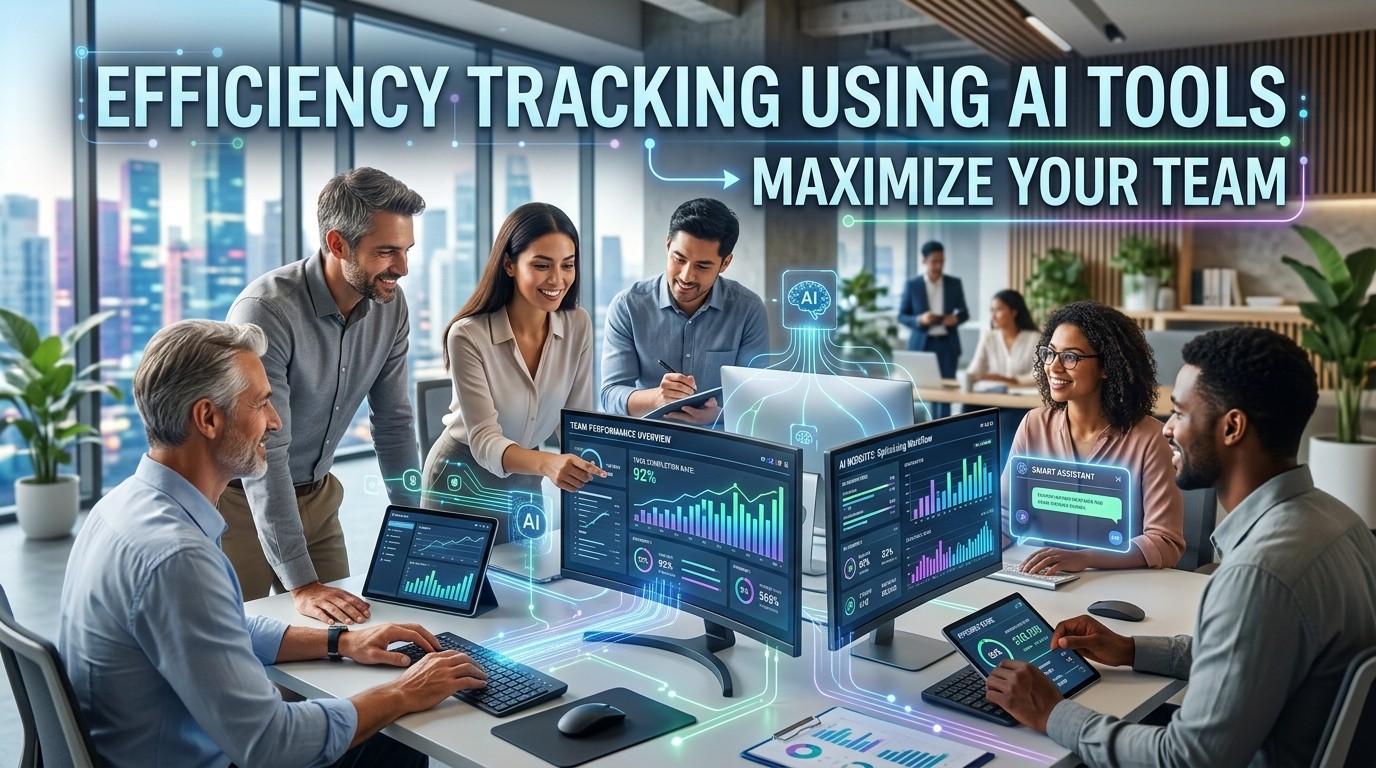
Efficiency Tracking Using AI Tools help teams find wasted time, expose slow workflows, and improve output through small process changes without adding more manual effort.
Efficiency Tracking Using AI Tools are becoming essential for SaaS, service teams, and growing digital businesses because the modern workplace is full of invisible friction. People spend time searching, switching tabs, rewriting updates, and trying to understand what changed. AI can help surface patterns, automate repetitive work, and turn raw activity into decisions. Google Cloud describes AI as a set of technologies that can learn, reason, understand language, analyze data, and provide helpful suggestions, which is why it fits naturally into measurement and optimization workflows.
The reason Efficiency Tracking Using AI Tools matter is simple: most teams do not suffer from a lack of activity; they suffer from a lack of clarity. Data is often scattered across dashboards, inboxes, CRMs, project boards, and spreadsheets. AI helps connect those signals so managers can notice bottlenecks sooner and act sooner. Atlassian says AI for project management can automate routine tasks, optimize resource allocation, and improve decision-making by analyzing historical data in real time.
A strong Efficiency Tracking Using AI Tools strategy is not about watching people more closely. It is about understanding how work moves, where waste appears, and how the team can keep the same output with less effort. That human-centered view matters. That makes the system easier to trust and improve over time and keep managers focused on meaningful action.
Why teams need a clearer view
Efficiency Tracking Using AI Tools become useful when leaders accept that efficiency is rarely obvious from the top level. A team may look busy and still be losing time through rework, unclear ownership, or weak handoffs. AI helps make those hidden patterns visible. Google Cloud says AI systems can understand language, analyze data, and provide helpful suggestions, which is exactly what teams need when the problem is not effort but visibility.
Efficiency Tracking Using AI Tools also support faster correction. If a process step keeps slowing down, the team can see the trend sooner and adjust the workflow instead of waiting until the quarter ends. That saves time and reduces frustration. Atlassian’s AI guidance makes a similar point: AI can help teams leverage insights from organizational data to streamline data-driven decision-making.
Efficiency Tracking Using AI Tools are especially helpful in cross-functional teams because each function sees the work from a different angle. Sales sees pipeline movement, marketing sees campaign response, operations sees throughput, and leadership sees output and risk. AI can bring those pieces into one view so the team stops arguing over impressions and starts acting on shared evidence.
What AI changes in daily work
Efficiency Tracking Using AI Tools change daily work by reducing the mental overhead of tracking. Instead of asking people to manually compile everything, AI can summarize, classify, score, and flag what matters. HubSpot says its AI-powered marketing software can help teams generate leads and automate marketing, while also using AI agents and connected data to make work faster inside the platform.
Efficiency Tracking Using AI Tools also make reporting more useful because they can turn many small signals into one readable pattern. HubSpot’s marketing analytics page says its analytics and dashboards help teams measure campaign performance in one place, identify top-performing assets, check site performance, and analyze multiple marketing channels together. That is important because fragmented data slows teams down more than people realize.
A good Efficiency Tracking Using AI Tools setup does not remove human judgment. It supports it. AI can show that a process is slowing, but a manager still has to decide why it is slowing and what change will help. The value comes from faster understanding, not from replacing human thinking. That keeps the team focused on decisions instead of dashboards and status noise.
Core metrics that deserve attention
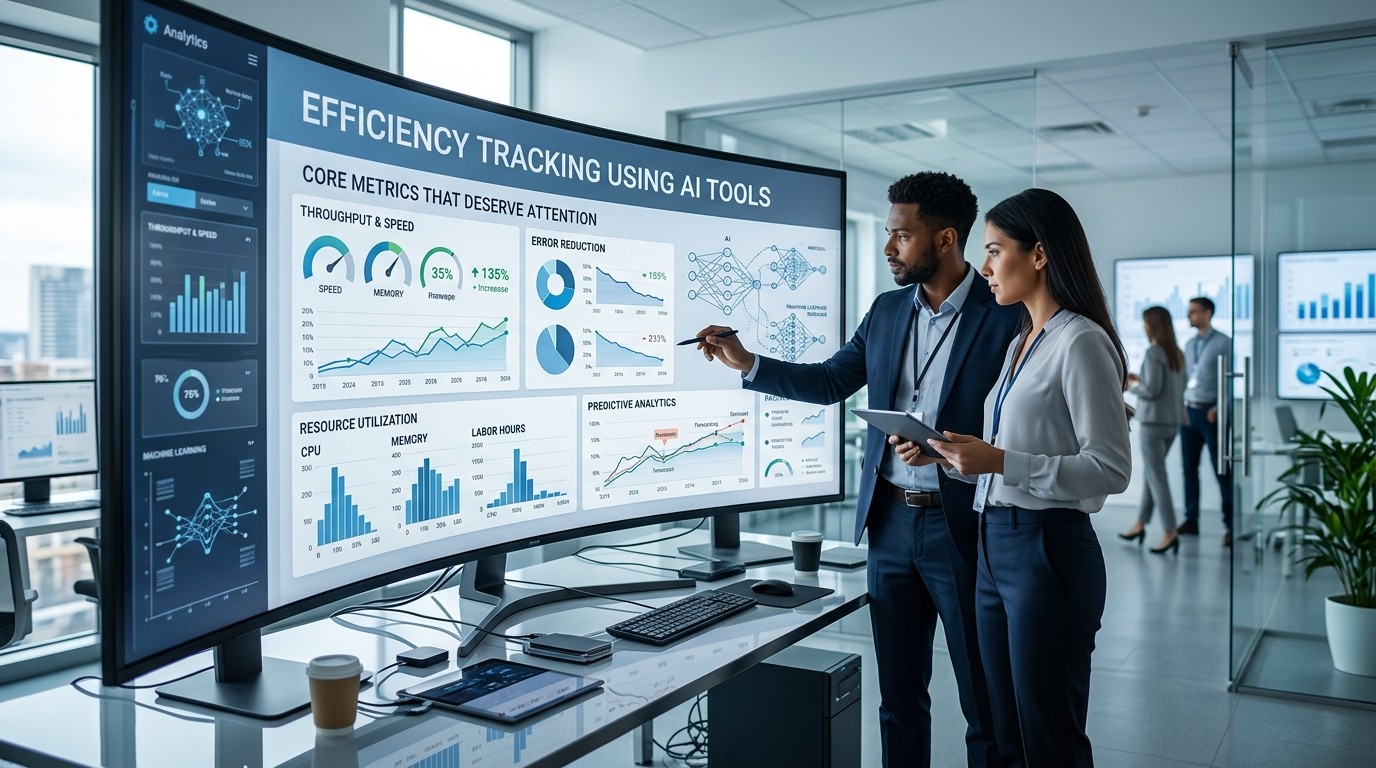
Efficiency Tracking Using AI Tools should begin with a small number of measurable outcomes. If the dashboard has too many vanity metrics, the team gets distracted. Better metrics show where the work stalls, where the output improves, and which activities create real business movement. Google Analytics says it helps uncover relevant customer insights and turn them into measurable performance improvements, while its Insights feature uses machine learning and configured conditions to help users understand and act on data.
Efficiency Tracking Using AI Tools are strongest when they track both volume and quality. Volume tells you how much work is moving. Quality tells you whether the movement matters. For a SaaS team, that might mean trial starts, activation rate, lead qualification, and conversion to revenue. For a service team, it might mean resolution speed, response quality, and repeat requests. The point is to avoid measuring activity that never turns into value.
Efficiency Tracking Using AI Tools also need trend metrics, not just snapshots. A single good day can hide a weak process, and a single bad day can hide a good one. AI helps because it can observe patterns over time and point out where the trend is actually moving. That long view is often more valuable than one number on one dashboard.
Dashboards should answer real questions
Efficiency Tracking Using AI Tools are only helpful when the dashboard answers practical questions. What is slowing the team down? Which process step repeats the most? Which channel brings the best results? Which segment needs more help? If the dashboard cannot answer those questions, it is too decorative. HubSpot’s reporting and dashboard pages emphasize drilldowns, sharing, revenue reporting, and customizable dashboard views, which is the kind of structure teams need when they are trying to improve performance instead of merely display it.
Efficiency Tracking Using AI Tools also work better when the team can compare current performance with prior performance. A trend line is more useful than a standalone number because it shows whether an intervention helped. AI can support that comparison by surfacing patterns automatically instead of forcing the team to build every report by hand. That saves time and reduces reporting fatigue.
Efficiency Tracking Using AI Tools should never become an excuse to ignore the operational reality behind the data. If a process is messy, the answer is not to make the dashboard prettier. The answer is to simplify the process, correct the bottleneck, and use AI to help confirm whether the change worked.
Marketing analytics in the modern stack
Efficiency Tracking Using AI Tools often overlap with broader reporting systems. HubSpot’s marketing analytics software says teams can measure all campaigns in one place, see website data, identify top-performing assets, and analyze performance across multiple channels. That makes the platform useful for teams that want to understand how content, email, and website behavior fit together.
Efficiency Tracking Using AI Tools also matter in digital marketing because AI is increasingly built into the tools themselves. HubSpot says its AI-powered marketing software includes AI agents, lead generation support, and automation features, while the company’s AI product pages describe 100+ AI features including writing emails, summarizing calls, and scoring leads. That reflects a larger market shift: AI is no longer separate from the workflow; it is embedded in it.
When people search for Efficiency Tracking Using AI Tools, they often really want a system that combines measurement and action. Marketing analytics alone is not enough if it does not change behavior. The best systems show what happened, explain what might matter, and make the next step easier to choose.
Tools people usually compare
Efficiency Tracking Using AI Tools become easier to evaluate when teams compare the right class of tools. If a company asks for the Top 5 Digital Analytics Tools, it usually wants platforms that can reveal customer behavior, campaign performance, and conversion patterns across channels. Google Analytics says it helps understand the customer journey across devices and platforms and can improve marketing ROI, which is why it remains a common benchmark.
Efficiency Tracking Using AI Tools also need a layered tool stack. Some tools are best for traffic and behavior. Some are best for CRM and lead management. Some are best for project visibility or collaboration. Atlassian says its AI-driven teamwork platform brings AI-powered insights into projects and knowledge, while Jira brings AI agents that orchestrate, plan, and track projects at scale. That matters because productivity is rarely a single-tool problem.
Efficiency Tracking Using AI Tools should be chosen according to the question the team needs answered. If the team wants to know where traffic is coming from, analytics tools matter. If the team wants to know which tasks are slowing execution, workflow tools matter. If the team wants to know which leads are moving, CRM and marketing tools matter.
Alignment across teams

Efficiency Tracking Using AI Tools work best when marketing, sales, and operations share the same truth. If one team measures success one way and another team measures it a different way, the organization loses time reconciling reports. That is why Marketing Alignment Tools matter. They help teams see the same signals, agree on definitions, and avoid the friction that comes from competing dashboards.
Efficiency Tracking Using AI Tools also make team alignment easier because AI can standardize summarization and reporting. If a weekly review takes too long, people start skipping it. If the same data can be summarized faster and shared more clearly, the conversation becomes easier to sustain. Atlassian says AI can help streamline data-driven decision-making, which is exactly what alignment needs.
Efficiency Tracking Using AI Tools are not just about collecting data. They are about helping people use the same data to make different roles work together. When the team trusts the same numbers, the team can move faster with less debate.
When to bring in an expert
Efficiency Tracking Using AI Tools become much easier to implement when someone knows how to connect the tools to actual business questions. A B2B Marketing Tools Expert can help a team decide which metrics matter, which dashboards should be built, and which workflows should be automated first. Tool selection is usually less about features and more about fit.
Efficiency Tracking Using AI Tools also benefit from expert guidance when the organization is overloaded with options. AI tools can collect a lot of signals, but signal overload is still a problem if nobody has a framework for interpreting the results. An experienced operator can translate the data into priorities, so the team does not drown in dashboard noise.
Efficiency Tracking Using AI Tools are at their best when they help the team answer one question clearly: what should we do next? The expert’s job is not to create complexity. It is to remove confusion, narrow choices, and make the system easier to operate.
Implementation roadmap
Efficiency Tracking Using AI Tools should be rolled out in stages. Start by defining the outcome you want to improve. Then identify the current bottleneck. Then choose the smallest AI-supported change that can improve that bottleneck. That approach keeps the rollout realistic and easier to measure. It also avoids buying too many tools too soon.
Efficiency Tracking Using AI Tools should also be tied to a baseline. If the team does not know current response time, conversion rate, cycle time, or handoff delay, it becomes hard to tell whether AI helped. A baseline creates a before-and-after picture. AI can then be used to confirm whether the process actually improved, rather than whether the team only felt busier.
Efficiency Tracking Using AI Tools also need a feedback loop. Once the new workflow starts, ask whether it makes work simpler, faster, or more accurate. If it does not, revise it. AI should reduce friction. The best implementation is the one people keep using.
| Step | What to do | Why it matters |
|---|---|---|
| Define the goal | Choose one efficiency problem to solve | Keeps the project focused |
| Set a baseline | Record current performance before changes | Makes improvement measurable |
| Add AI support | Apply AI where repetition or analysis is heavy | Reduces manual work |
| Review results | Compare output before and after | Confirms whether the change helped |
| Refine the workflow | Keep improving the process | Turns a tool into a system |
Efficiency Tracking Using AI Tools become useful when the team treats the rollout as a process improvement project, not a software installation. That mindset creates better adoption and better patience. People usually resist tools less when they can see how the tools make their daily work easier.
Common mistakes
Efficiency Tracking Using AI Tools can fail when teams expect magic. AI is helpful, but it is not a substitute for a clear workflow. If the underlying process is broken, the software will only reveal the problem faster. That is useful, but it is not the same as fixing the problem.
Efficiency Tracking Using AI Tools also fail when the team tracks too many things at once. Too many metrics create noise. Too many alerts create fatigue. Too many reports create mistrust. The smartest approach is to focus on the signals that matter.
Efficiency Tracking Using AI Tools can also fail when leaders over-automate without trust. If every action is automated before the team understands the pattern, the result can feel opaque. AI works best when humans can still understand what changed and why. Transparency matters because people adopt tools more easily when the logic feels explainable.
Using AI without losing judgment

Efficiency Tracking Using AI Tools should help teams think better, not think less. The ideal setup uses AI to surface patterns, summarize the obvious, and highlight what needs attention. But the team still has to interpret the findings, decide what matters, and choose the right response. AI is not the manager. It is the assistant that makes better management possible.
Efficiency Tracking Using AI Tools also work best when the organization values curiosity. If the team asks why one pattern happened, AI becomes more useful. If the team only wants a prettier report, the value is limited. Curiosity turns data into learning, and learning turns into improvement.
Efficiency Tracking Using AI Tools should therefore be treated as a support structure for judgment. The more the team learns how to read the signals, the more useful the AI becomes. The software gives leadership a better view.
Why this matters for growth
Efficiency Tracking Using AI Tools are closely tied to growth because growth depends on efficiency. If the team can produce more useful work with the same or fewer resources, the business has more room to scale. That is true in marketing, operations, service, and product work alike. Efficiency is not a side goal; it is often the thing that makes expansion possible.
Efficiency Tracking Using AI Tools also make it easier to spot which work creates the most value. Once the team knows what moves the business forward, it can spend less effort on low-value repetition. That improves margins, reduces burnout, and makes planning more stable. In a busy organization, those benefits can be as important as top-line growth.
Efficiency Tracking Using AI Tools are therefore both a measurement strategy and a management strategy. They help teams see what is happening, decide what to fix, and keep improving without constantly adding more people or more manual review.
Conclusion
Efficiency Tracking Using AI Tools help teams make work visible, reduce wasted effort, and improve decision-making without turning processes into reporting chores. The strongest systems use AI to surface patterns, measure progress, and highlight what deserves attention, while still leaving final judgment to people. That balance is what makes the approach sustainable. If the team starts with a clear baseline, focuses on one bottleneck at a time, and uses the right tools for the right questions, the gains can compound. Good measurement is not about watching more closely; it is about working more clearly and getting better results.
Frequently Asked Questions (FAQ)
1. What are Efficiency Tracking Using AI Tools?
Efficiency Tracking Using AI Tools are systems that use artificial intelligence to measure how work moves, identify bottlenecks, and help teams improve output with less manual effort.
2. Why do teams need them?
They help teams see what is slowing work down and what is driving results. That makes it easier to improve performance without relying only on guesswork.
3. Are they only for marketing?
No. They can be used across marketing, sales, operations, service, and project management. Any process with repeatable work can benefit from better tracking.
4. How do they connect to analytics?
They often sit on top of Marketing Analytics Tools or broader reporting systems so the team can see patterns across channels and actions in one place.
5. What makes a good dashboard?
A good dashboard answers real questions, shows trends instead of only snapshots, and helps the team decide what to do next.
6. Do these tools replace managers?
No. They support managers by surfacing patterns and reducing manual work, but human judgment is still required to interpret the data and choose the right response.
7. Why is alignment important?
Because teams need shared definitions and shared data. Marketing Alignment Tools help different departments use the same language and avoid conflicting reports.
8. When should a company bring in an expert?
A company should bring in a B2B Marketing Tools Expert when it needs help choosing tools, setting baselines, or connecting AI outputs to business goals.
9. What is the biggest implementation mistake?
The biggest mistake is trying to automate everything at once. Start with one bottleneck, measure it, and then expand gradually.
10. What is the main benefit long term?
The main long-term benefit is compounding efficiency. As the team learns what works, the system becomes easier to run, easier to scale, and easier to improve over time.