
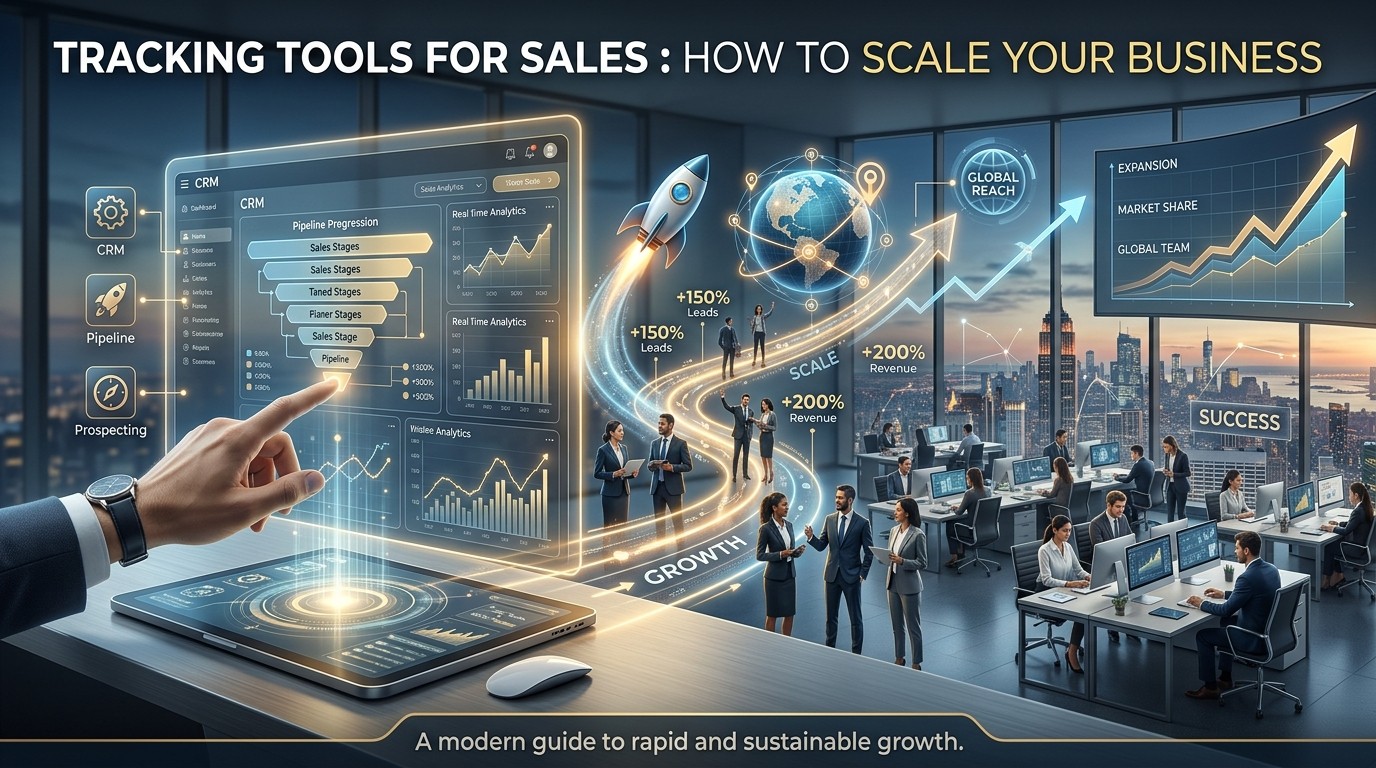
Sales visibility helps leaders make faster decisions, reduce waste, and scale with confidence by showing exactly where demand grows, where it slows, and where revenue is being lost.
Tracking Tools For Sales matter because growth becomes much easier when a business can see what is happening instead of guessing. Many companies work hard, spend on ads, and push their teams to sell more, but they still cannot explain why one month looks strong and the next month falls flat. That confusion is expensive. Tracking Tools For Sales give structure to that uncertainty by turning activity into measurable insight. When the numbers are clear, leaders can stop reacting emotionally and start improving the parts of the process that actually matter.
Tracking Tools For Sales also help businesses avoid the common trap of focusing only on surface-level wins. A big jump in traffic, a busy pipeline, or a rise in clicks does not automatically mean the business is healthy. Revenue depends on how the full journey performs, from first contact to final sale and beyond. With Tracking Tools For Sales, the team can see whether leads are high quality, whether deals are moving forward, and whether customers are returning after the first purchase. That shift in visibility changes everything.
Scaling is rarely about doing one thing perfectly. It is about doing many small things consistently better. Tracking Tools For Sales make that possible because they reveal patterns that are otherwise easy to miss. A sales team may think the problem is lead volume when the real issue is follow-up timing. A store may think it needs more traffic when the actual challenge is checkout friction. With Tracking Tools For Sales, the business can diagnose the real bottleneck and scale with more control.
Why measurement changes growth
Tracking Tools For Sales are valuable because they turn opinions into evidence. When a team can see how many leads enter the pipeline, how many move forward, and how many close, it becomes easier to understand where performance is strong and where it is weak. This reduces debate and replaces vague statements with specific action.
Tracking Tools For Sales also make scaling less emotional. Leaders often feel pressure to move quickly, but speed without clarity can waste time and money. With Tracking Tools For Sales, the business can identify the campaigns, reps, products, and offers that truly support growth. That means resources can move toward the parts of the business that deserve more attention instead of being spread too thin.
Another reason Tracking Tools For Sales matter is that they create accountability. A good system shows which actions produce results and which ones do not. That encourages better habits across the team. When people know they can see the numbers, they tend to work with more discipline. Tracking Tools For Sales therefore support both strategy and culture, which is why they are so useful for companies that want long-term growth rather than short-term noise.
The psychology behind performance visibility

People respond to what they can measure. That is one reason Tracking Tools For Sales influence behavior so strongly. When a goal is visible, it feels more real. When progress is visible, it feels more rewarding. When problems are visible, they are harder to ignore. Tracking Tools For Sales create this effect by making the sales journey concrete instead of abstract.
The human mind also likes certainty. When a team can see patterns, confidence rises. Tracking Tools For Sales reduce the stress of guesswork because they show where the process is working and where it needs repair. A manager can coach with facts instead of frustration, and a rep can focus on the stage of the funnel that matters most. That clarity improves both performance and morale.
Tracking Tools For Sales also support better decision-making under pressure. If a lead source suddenly weakens, the team can respond quickly because the trend is visible. If a product line starts converting better than expected, the business can shift attention without hesitation. Tracking Tools For Sales are powerful because they help leaders move from reaction to intention, and that psychological shift is often what unlocks growth.
What to track first
The most useful systems begin with the right numbers. Tracking Tools For Sales should not collect data for the sake of collecting data. They should highlight the metrics that truly explain performance. The first group of numbers usually includes lead source, conversion rate, average deal size, close rate, and sales cycle length.
These measurements show the shape of the pipeline. Tracking Tools For Sales become especially valuable when each number is connected to a decision. If a lead source is producing poor-quality prospects, the business can reduce spend there. If a sales cycle is getting longer, the team can investigate whether follow-up is slow, the offer is unclear, or the market is changing. The value comes from what the numbers allow the team to do next.
Tracking Tools For Sales should also reflect the business model. A subscription company may care deeply about retention and lifetime value. A service business may care about proposal acceptance and project size. A store may care about repeat buyers and product-level performance. The right metrics make the system useful, and useful systems are the ones that help leaders grow with confidence.
Sales funnel clarity
Every business has a funnel, even if it is not drawn on a whiteboard. Tracking Tools For Sales help make that funnel visible from first contact to final purchase. That means the business can see which stage brings in attention, which stage builds interest, and which stage closes revenue.
Tracking Tools For Sales are especially helpful when the funnel breaks in a subtle way. A company may have plenty of leads but low conversion. Another may have strong demos but weak follow-up. Another may have good sales calls but poor deal size. Tracking Tools For Sales expose those differences so the right fix can be applied at the right stage.
This clarity matters because not every problem is a sales problem in the same way. Some issues begin in marketing, some in product positioning, and some in operations. Tracking Tools For Sales connect these moving parts so the business sees the whole journey, not just the final transaction. That is what makes scaling more deliberate and far less chaotic.
Ecommerce data that actually helps
Ecommerce businesses need especially careful visibility because the customer journey can be short, fast, and full of small friction points. Tracking Tools For Sales are useful in ecommerce when they show how visitors move from product discovery to cart to checkout to repeat purchase. Without that view, it is easy to misread a store’s performance.
One of the most important areas is conversion behavior. Ecommerce Metrics To Track usually include product page conversion, cart abandonment, checkout completion, average order value, and repeat purchase rate. These metrics show whether traffic is just browsing or actually buying. Tracking Tools For Sales make it easier to tell the difference, which is essential for any online store that wants to grow profitably.
Tracking Tools For Sales also help ecommerce leaders understand the quality of their merchandising. A product may attract clicks but not purchases. Another may sell well only when paired with a discount. Another may bring repeat buyers but low initial margin. Tracking Tools For Sales make these tradeoffs visible, which helps the business invest in the right products and the right messages.
Why returns deserve attention
Returns are not just an operational issue. They are a growth signal. Tracking Tools For Sales become much more useful when they include return data because returns can reveal hidden problems in product fit, expectations, shipping, or quality.
Ecommerce Returns Tracking can show whether a specific product is being returned too often, whether certain size groups create problems, or whether a certain marketing angle is attracting the wrong buyers. Tracking Tools For Sales help the business see these patterns before they damage profit too deeply. A high return rate can erase the benefit of a strong sales month if it is ignored.
Tracking Tools For Sales should therefore connect returns with the original sale. That makes it easier to ask the right questions. Was the description unclear? Were the photos misleading? Was the shipment delayed? Was the product not what the customer expected? With the right tracking, the answers become easier to find, and the business can improve both margin and trust.
Reporting that people will use
A report only matters if people actually read it. Tracking Tools For Sales should be built around simplicity, relevance, and regular use. If the dashboard is too complicated, the team stops checking it. If the data is too delayed, the insight arrives after the opportunity has passed.
Tracking Tools For Sales work best when the report layout matches the role of the user. A founder may need a quick revenue and forecast view. A sales manager may need pipeline health and rep activity. A marketer may need lead quality and channel performance. Tracking Tools For Sales become more useful when every team sees the numbers that help them make decisions.
It also helps to keep metric definitions stable. If one report counts a lead in one way and another report counts it differently, trust drops. Tracking Tools For Sales are only valuable when the team believes the numbers are accurate and meaningful. Clean reporting discipline turns raw data into a reliable decision system.
Building a rhythm around the data
The best tracking systems work on a schedule. Tracking Tools For Sales should not be checked randomly whenever someone has time. They should support a rhythm of weekly, monthly, and quarterly review.
Weekly review is for immediate movement. It helps the team see lead flow, active deals, campaign shifts, and any sudden issues. Monthly review is for patterns. It shows which channels are improving, which offers are working, and where the sales process is changing. Quarterly review is for strategy. It helps the business decide where to expand, where to cut back, and what should be tested next. Tracking Tools For Sales become far more powerful when the review schedule matches the speed of the business.
This rhythm also creates team confidence. Everyone knows the numbers will be looked at regularly, so issues do not have to be fought in chaos. Tracking Tools For Sales help create this discipline, and discipline is one of the quietest drivers of scaling.
Automation and integration

Manual reporting can work for a small team, but it becomes inefficient fast. Tracking Tools For Sales are most effective when they pull data from connected systems such as CRM, ecommerce platforms, customer support tools, and marketing channels. That reduces duplicate work and improves accuracy.
Integration also gives the business a full view of the customer lifecycle. Tracking Tools For Sales can connect the first click to the final sale, and the final sale to the support experience afterward. That broader view matters because growth is not just about acquisition. It is also about retention and satisfaction.
A good setup should be as automated as possible without becoming hard to manage. Tracking Tools For Sales should make the team faster, not busier. When automation is done well, reports appear on time, leaders see what matters, and decisions are made with less friction.
Website experience and sales behavior
User experience matters more than many teams realize. A Sticky Header Plugin can make navigation easier because visitors do not lose access to menus or key links while scrolling. That can reduce friction and help people move through the site more smoothly.
Tracking Tools For Sales become even more valuable when the website supports good behavior. If users can find products, content, or calls to action without extra effort, the sales path becomes clearer. A Sticky Header Plugin may seem small, but in a long sales page or store, it can support a better journey and, indirectly, better conversion.
The lesson is simple: the better the experience, the easier it is to measure true performance. Tracking Tools For Sales should not be isolated from design. They work best in a website environment that already helps visitors take the next step.
Small design details with big effects
A Custom Scrollbar Plugin may feel cosmetic, but visual detail shapes trust. A polished browsing experience can make a site feel more professional, more consistent, and more intentional. That impression can influence how long users stay and how comfortable they feel while exploring offers.
Tracking Tools For Sales should be used alongside a thoughtful interface because design and behavior are connected. If a page feels clumsy, users may leave before converting. If the design feels clean and easy, the tracking data becomes more meaningful because it reflects real engagement rather than frustration.
This is especially important on longer pages or product catalogs. A Custom Scrollbar Plugin can help the site feel more refined, while Tracking Tools For Sales show whether that refinement is translating into stronger user behavior. The point is not decoration. The point is better performance through better experience.
Forecasting growth more accurately
Forecasting gets much easier when patterns are visible. Tracking Tools For Sales allow leaders to estimate future results based on current behavior instead of hope. If a channel consistently brings in a certain number of qualified leads, and those leads close at a known rate, the business can project next month or next quarter with greater confidence.
Tracking Tools For Sales also help a team spot changes early. If close rates fall, the forecast can be adjusted before the business overcommits resources. If average deal size rises, the business may be able to invest more aggressively. That kind of planning is what turns growth from a vague goal into a managed process.
Ecommerce teams benefit in the same way. If orders are rising but returns are also rising, the forecast needs to account for margin pressure. Tracking Tools For Sales support both revenue projection and profitability planning, which makes them important for scaling in a healthy way.
Common mistakes that slow growth
One of the biggest mistakes is measuring too much and learning too little. Tracking Tools For Sales should focus attention, not scatter it. If the dashboard contains every possible number, the business may drown in noise and miss the signal.
Another mistake is treating top-line activity as success. More visits, more calls, or more clicks do not always mean more revenue. Tracking Tools For Sales should emphasize metrics tied to actual business outcomes. That keeps the team honest about what is really happening.
A third mistake is ignoring the numbers after they are collected. If the team sees a problem but never acts, the tracking system becomes a decoration. Tracking Tools For Sales only matter when they lead to a change in offer, process, messaging, or follow-up. Data without action is just a busy spreadsheet.
Team culture and accountability
Strong tracking systems do more than measure outcomes. They shape culture. Tracking Tools For Sales work best in a team that values clarity, learning, and responsibility. When everyone knows what is being measured, it becomes easier to align effort and expectations.
That culture should feel supportive, not threatening. The point of Tracking Tools For Sales is to help people improve, not to punish them for every weak week. When managers use data to coach instead of criticize, the team becomes more open and more willing to learn. That often improves performance faster than pressure alone.
Tracking Tools For Sales also create a fairer environment. If the numbers show who is doing well and why, recognition becomes more objective. If the numbers show where support is needed, help can be given earlier. Over time, that kind of culture makes growth more sustainable.
A practical starting point
The easiest way to begin is to choose a few metrics that directly support revenue. Tracking Tools For Sales do not need to start with a huge dashboard. They need to start with the numbers the business actually uses to make decisions.
Set clear ownership for each metric. Someone should be responsible for making sure the data is accurate, reviewed, and acted on. Tracking Tools For Sales work best when they are part of a process, not a one-time project. A dashboard that nobody owns will usually stop being useful.
Then schedule regular review. The team should talk about the numbers, not only look at them. Tracking Tools For Sales become more valuable when the conversation leads to an action plan. This is how a tracking habit turns into a growth habit.
Scaling with better decision-making

Scaling is not just about selling harder. It is about understanding where effort creates the most return. Tracking Tools For Sales show which channels deserve more budget, which reps need more support, which products deserve more attention, and which bottlenecks are holding the company back.
That kind of clarity makes growth more predictable. Instead of guessing what to fix, the business can identify the leverage point. Tracking Tools For Sales support this by making performance visible at each stage of the journey. Once the data is clear, the business can move faster without losing control.
A company that uses tracking well often feels more stable even while it grows. That is because decisions are based on evidence. Tracking Tools For Sales help create that stability, and stability is what allows growth to continue without unnecessary chaos.
Conclusion
Scaling a business becomes much more manageable when the team can see the full picture. Sales performance is rarely determined by one number, one rep, or one campaign. It is shaped by a chain of decisions, customer responses, and operational choices. When those signals are tracked clearly, the business can identify patterns, fix bottlenecks, and invest with more confidence. Good tracking also improves team discipline, strengthens reporting habits, and helps leaders forecast future revenue more accurately. In the long run, the companies that grow most reliably are usually the ones that measure what matters and act on it consistently. That is how visibility turns into strategy, and strategy turns into scale.
Frequently Asked Questions (FAQ)
1. What are the most useful metrics for a growing business?
The most useful metrics usually include lead source, conversion rate, average deal size, close rate, and sales cycle length.
2. Why should ecommerce brands track returns?
Returns can reveal product, marketing, or fulfillment issues that reduce profit and customer trust.
3. How often should sales reports be reviewed?
Weekly for immediate activity, monthly for patterns, and quarterly for strategic planning.
4. What makes a sales dashboard effective?
It should be simple, relevant, accurate, and easy for different roles to use.
5. Do design features affect sales performance?
Yes. Better navigation and a cleaner interface can improve user behavior and support stronger conversion.
6. What is the biggest mistake companies make with tracking?
They track too much data and fail to turn the insight into action.
7. How does tracking help with forecasting?
It shows patterns in leads, conversion, and revenue so future planning becomes more accurate.
8. Can small businesses benefit from tracking systems?
Yes. Small businesses often benefit quickly because they can spot bottlenecks early and adjust faster.
9. Should different teams see different reports?
Yes. Founders, managers, marketers, and sales reps often need different views of the same data.
10. What is the first step to improving sales visibility?
Choose a few revenue-linked metrics, assign ownership, and review them on a fixed schedule.


